
The Volatility of the New Ofsted Framework for Primary Schools
3 March 2026
By Dr Keven Bartle
This blog is the third instalment where we are looking at data from our tracking of Ofsted inspection reports, to show how the new framework is playing out for schools. Here we focus on primary schools and outline how the new framework and inspection processes appear to more challenging for this sector.
Recap: The new inspection framework across all education settings
The table below shows the proportion of improvement needs linked to different areas of the new Ofsted framework for all settings. This has been retrospectively applied in the first two columns of data when education settings were, of course, inspected under the previous framework. The final column shows the change in inspection focus since the last academic year.
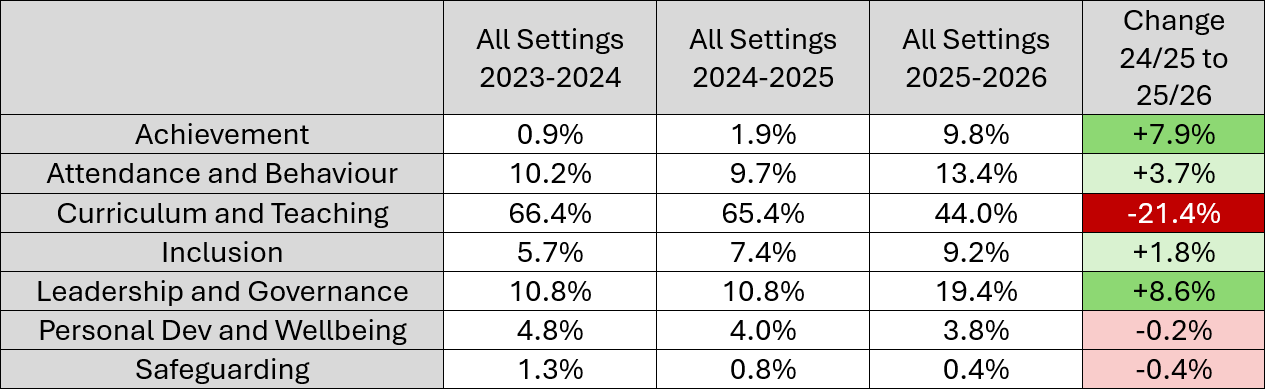
As outlined in a previous blog, this shows that there has been significantly less focus on the curriculum and teaching, down by more than a fifth year-on-year on top of a small decrease between 2023-24 and 2024-25. Personal development/wellbeing and safeguarding have also been less likely to be seen as an improvement need (now ‘next steps’ by inspection teams) and these too are part of a longer pattern of waning attention since we began tracking inspections.
The introduction of the new framework since November 2025, has seen a marginally increased focus on inclusion, although my previous blog argues that the data on specific needs, shows that Ofsted are focusing on inclusion as a lens for some of the other judgement areas. There has also been a notable increase in focus on attendance ad behaviour, but it is important to note that ‘next steps’ around behaviour are declining rapidly, with focus on attendance increasing.
The biggest areas of growth in terms of inspection focus, since the new framework became operational, are around achievement and leadership and governance, with the latter now accounting for almost one in five ‘next steps’ since November. But these changes are amplified significantly when we look at the same data for primary schools inspected recently.
Volatility: Primary schools and the new inspection framework
The table below shows the same data for primary settings only. Below this, to aid comparisons, is the same data for secondary settings.
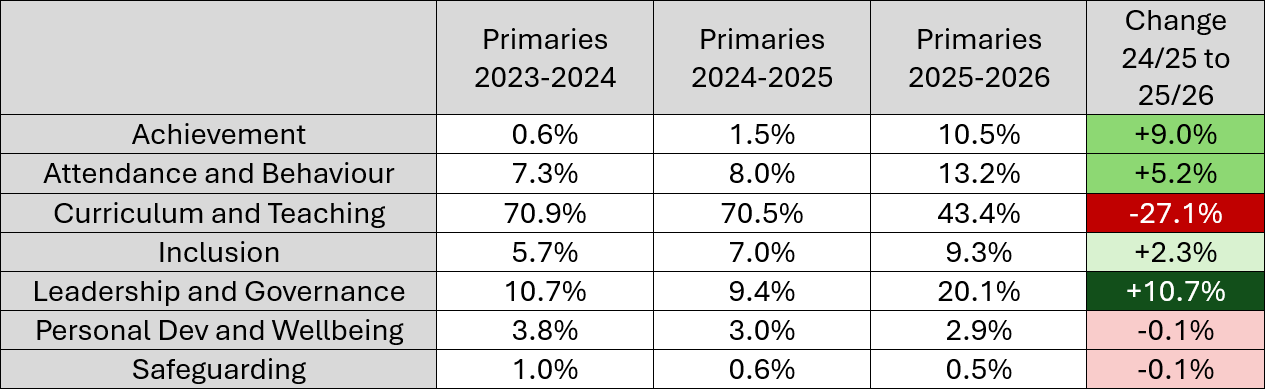
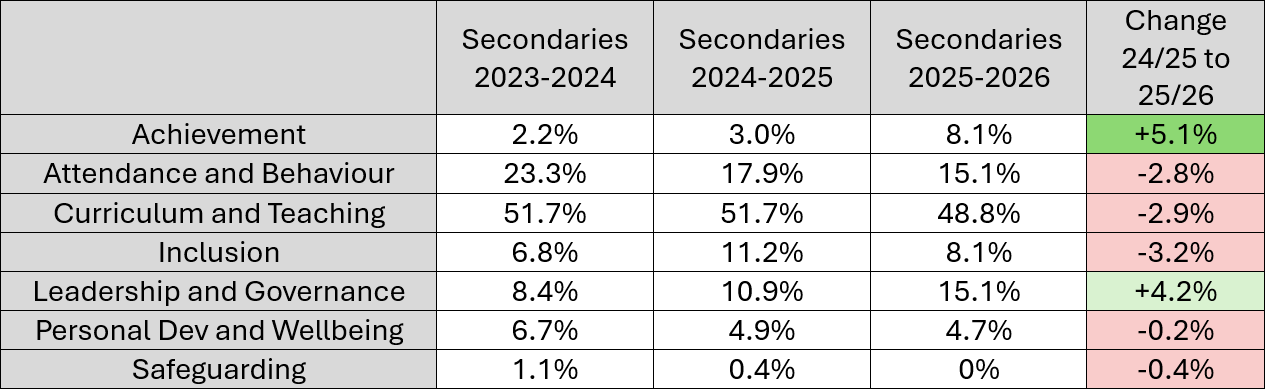
This data indicates that the volatility that comes with a change of inspection schedule has been much more profound for primary settings than for secondaries.
Curriculum and teaching has been a staple for primary inspections since September 2023, accounting for close to three-quarters of all improvement needs throughout the last two full academic years. Since November 2025, this has dropped to much less than half of all improvement needs. By comparison, secondary settings have seen only a small decrease in focus on curriculum and teaching and are now more likely to have a ‘next step’ focused on curriculum and teaching than primaries. This represents a major change in focus for primary settings.
Across both sectors, we see the increased focus on the achievement and the leadership and governance judgements. But these changes are far more significant for primary schools, reflecting again the higher levels of volatility caused for primaries by the implementation of the new framework so far. The risk of having achievement identified as a next step, for example, has increased six-fold since last academic year and fourteen-fold since the 2023-24 academic year. The risk of having a next step for leadership and governance has doubled since last year.
Primary schools have also seen a sizeable increase in the focus on attendance and behaviour (in reality, attendance) where secondaries have seen a not-insignificant decreased focus on this area. Challenges around the inclusion judgement have also increased for primaries whilst decreasing for secondaries since last year and it is now more likely as a next step for the primary sector than for the secondary sector.
Volatility: Primary schools and the new ‘next steps’ recommendations
The table below show the most frequent ‘need to improve’ comments published in inspection reports for primary schools between September 2023 and July 2025 under the old framework in the left-hand columns. The right-hand columns show the most frequent ‘next steps’ for primary schools between November 2025 and January 2026 under the new framework.
The dark red shows where the frequency has decreased by 2.5% or more, light red where the decrease is between 0.1% and 2.4%. The dark green and light green indicate increases of frequency by the same proportions.
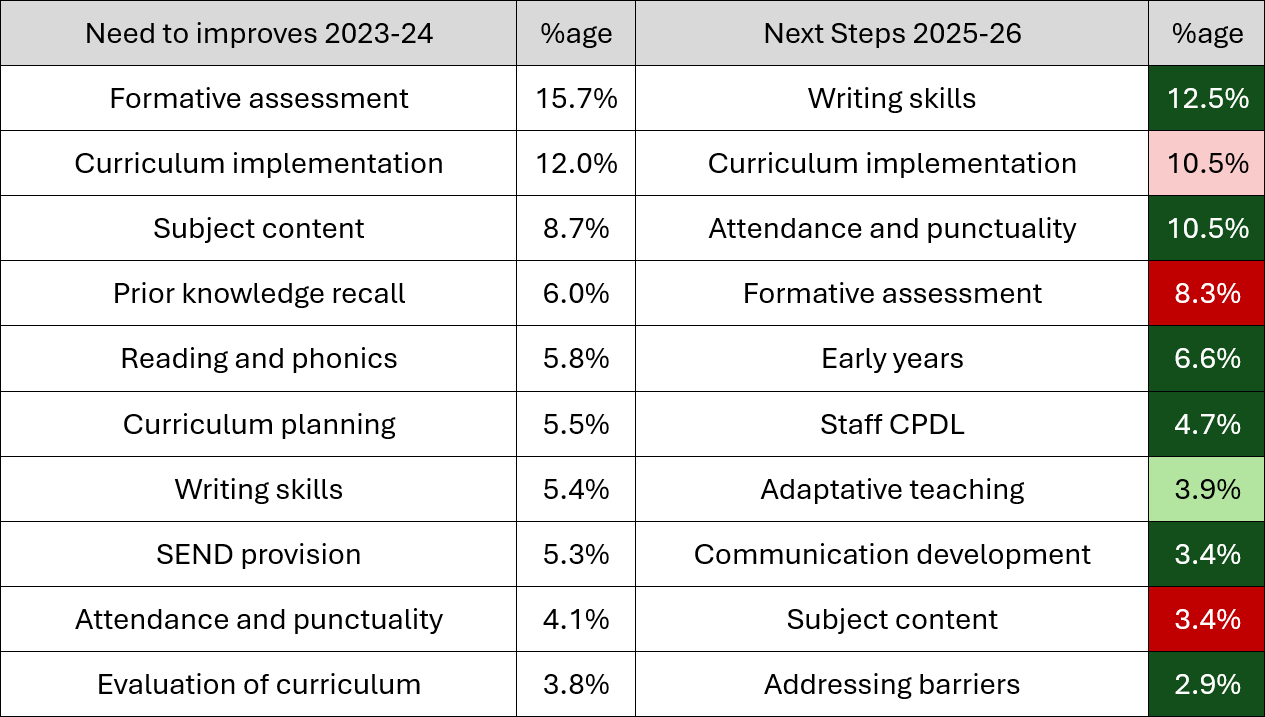
What stands out is that all but two of these top ten next steps under the new Ofsted framework, are either significantly increasing or significantly declining in frequency since the 2019 framework was shelved. Interestingly, the next steps that are either decreasing or only gently increasing in frequency are all related to the curriculum and teaching provided by these schools.
The increased focus on inclusion as a lens for other judgements is highly visible. Attendance, foundational skills such as writing and communication are increasingly coming into focus for Ofsted when looking at primaries, as is the Early Years and other ways in which primaries are addressing the barriers to learning and achievement faced by children.
Under this new framework in practice, the early signs are that primary schools are facing very significant upheaval not only in terms of the broad areas of the new framework, but also in terms of the specific elements of these headline areas.
The Impact of Volatility? Primary school gradings compared to other settings
The final table (below) shows the mean gradings for the two phases for which we have enough data to make claims about its reliability, the primary and secondary sectors. To achieve a mean grading, we have given a score of 5 for an exceptional judgement, a 4 for schools achieving the strong standard, and so on down to a 1 for urgent improvement.
This table shows the mean grades for these sectors and has been colour-coded red to show where the mean for the sector is below the mean for all phases, and green where it is higher than the mean for all phases.
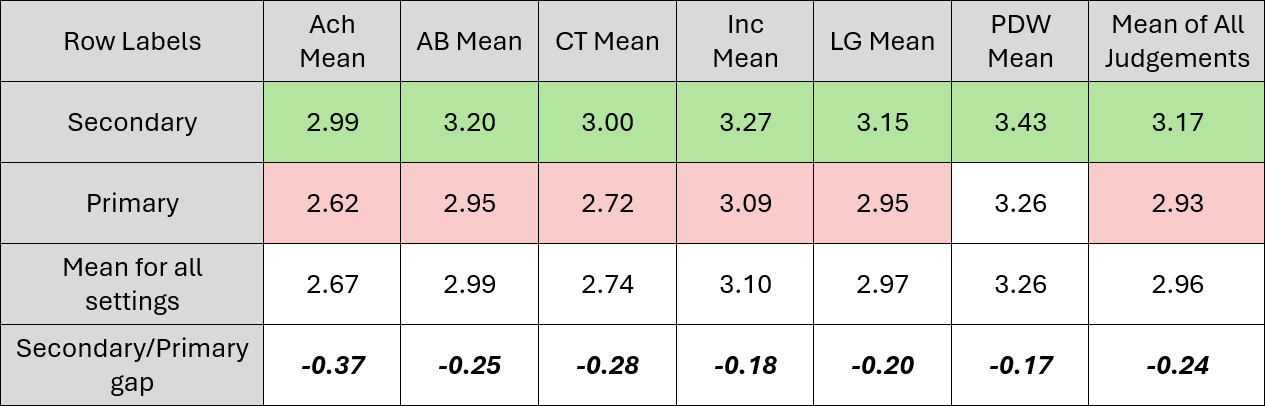
As can be seen, except for the personal development and wellbeing judgement (which happens to be the least stringent of all judgements), primary schools are performing less well than is the case for all settings.
Against the outcomes for secondary schools, primaries are achieving on average almost a quarter of a grade lower across every judgement area. The starkest difference between primary and secondary schools is for the achievement judgement, in which primaries are being judged more than a third of a grade lower on average. Primaries are also faring particularly badly, in comparison to secondaries, on curriculum and teaching and on attendance and behaviour.
Conclusions: A volatile time for primaries under Ofsted
This blog has shown the volatility of the shift from the 2019 Ofsted inspection schedule to the new 2025 framework since November last year. More importantly, it has demonstrated that this volatility has not been evenly distributed across schools but is falling more heavily on the primary sector.
- The change to seven common areas of inspection from the previous four has radically altered what inspection looks like for primaries, with far less focus on curriculum and teaching and far more focus on achievement and leadership and governance. The scale of this shift in focus is far greater for primary settings than for secondary counterparts.
- Within these broad headings, we have also shown that the specific improvement needs for primaries are also highly volatile compared to what has gone before. Inclusion as a lens is significantly shaping what Ofsted are focusing on with primaries, with much more attention being paid to how schools build foundational skills and address barriers.
- Mean grades across almost all elements of the new framework are lower for primaries than for all settings inspected since November, and primaries are faring particularly badly under the new Ofsted framework when compared to secondaries, most notably in terms of the achievement judgement.
What might be driving or explaining these patterns in inspection data?
During the consultation and implementation of the new framework, several commentators spoke about the frenetic and relentless nature of the new framework for school leaders. Many suggested that smaller schools with smaller leadership teams might struggle with this fast-paced and incessant approach to information-gathering during the inspection process. Perhaps this is a factor that is playing out during the full roll-out of the new Ofsted experience.
Alternatively, perhaps the changes we are seeing in the primary experience of inspection is pointing to something more fundamental still. Is it possible that the new inspection framework, and not just the inspection process, is more secondary-friendly? Whilst a stronger focus on inclusion is welcome, might the enhanced focused on foundational knowledge, habits and skills be putting primaries under greater pressure than is the case for secondaries?
Linked to this, there is a question to be asked about why achievement gradings are so very different for primaries than for secondaries. Is the enactment of the new framework placing higher expectations upon the achievements of students in primary settings than those at secondary levels? Are secondaries being given more latitude around achievement levels? Are they benefitting from having more subject specialists, or for having better resources and support staff capacity to support interventions?
One thing is clear, whatever your feelings about the questions raised above: the switchover from the 2019 to the 2025 Ofsted inspection framework is changing inspection for primaries quite profoundly. School and trust leaders should be aware of this, as should be those of us who work to support them in their readiness for inspection.
If you are interested in learning more about what our inspection tracker is telling us about the new framework in action, we regularly run webinars to provide insights for school leaders. We have also put together an audit tool for inspection readiness, and are happy to provide bespoke support for schools related to this. Feel free to book a call to find out more about how we can help you in this crucial area of school leadership.
Read more analysis of the new Ofsted framework
This blog is the third instalment where we are looking at data from our tracking of Ofsted inspection reports, to show how the new framework is playing out for schools. Read the previous instalments below:
Read now: How the new Ofsted framework is changing inspections
Read now: A rose by any other name? Reading across old and new Ofsted inspection gradings
Discover more in our webinar
If you have learned something from these insights and would like to delve deeper into our analysis of the new inspection process, you can join us for our upcoming Readiness for Ofsted Inspection webinar.
If you would like to know more about how we can mobilise our insights to support your school in its readiness for Ofsted inspection work, you can book a call to discuss the options available to you.
Dr Keven Bartle, Senior Education Lead, SSAT

Keven has been a teacher for almost three decades and was headteacher at a richly diverse secondary school in London for nine years. Through his career, Keven has been committed to the power of education for social justice and transformation, working in schools where staff make a difference to the lives of children, families and communities.
Recommended
Readiness for Ofsted Inspection Audit Tool
Set your school or MAT up for success with the new Ofsted framework. Our invaluable new audit tool for school leaders ensures you are fully prepared when your call comes.
Ofsted Inspection Insights
We have the data from every Ofsted inspection ready for you. Learn the emerging trends and the issues facing schools with our comprehensive, segmented analysis of inspection reports.
ASSIST
If you need rapid, focused improvement right now, we can support you with a bespoke, hands-on, strategic programme tailored to your specific needs.
School improvement solutions
Working sensitively within your context, we work with you and your team to support you to overcome the different challenges you are facing. From attendance and behaviour, working with parents to DEIB and more.
Framework for Exceptional Education
Wherever you are in your school improvement journey our trusted framework supports self-review and action planning. Covering 12 key areas of practice.
Back to top
