

The new Ofsted framework promised to focus on inclusion. Achieving, belonging and thriving sit at the heart of the new inspection processes. As the most critical facet of inclusion, attendance should be reflected in the reality of school’s experiences of inspection, not just the rhetoric.
SSAT have been tracking every inspection report published since September 2023. In this fourth post about the data emerging from Ofsted reports since November, we will look at how often attendance is appearing on inspection reports and how this is impacting upon the new gradings.
And, for the first time, we will be correlating Ofsted’s data on deprivation and additional needs with attendance and behaviour judgements. Is an inclusion-focused inspection framework proving itself to be sensitive to the challenges to inclusion faced by schools where attendance is more likely to be impacted by cohort needs?
How frequent are attendance next steps in the new framework?
The first table shows the proportion of ‘Attendance and Behaviour’ next steps from Ofsted reports under the new inspection framework (right hand column). In the two columns before this, to enable comparisons, we have mapped the old ‘need to improve’ comments from Ofsted reports in the last two academic years against the new framework.
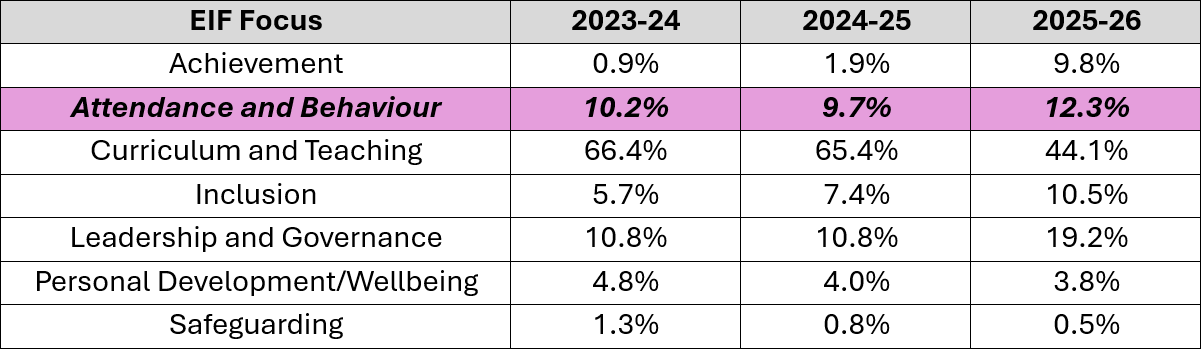
From this we can see that the new framework – and the processes that underpin it – has led to a significantly increased focus on attendance and behaviour: next steps for this area of inspection activity are up by a third on those in 2024-25. However, this doesn’t tell the full story around what is happening with attendance, which is up by much more as shown below.
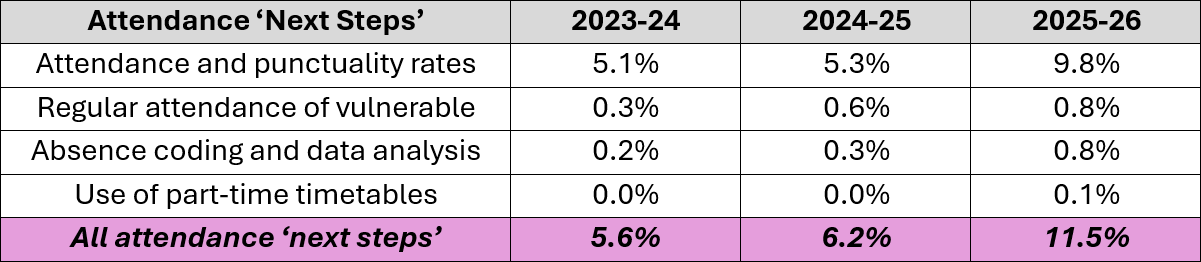
As you can see, all attendance improvement needs have increased under the new framework. Added together, they have come close to doubling in frequency since last academic year and have more than doubled in comparison to 2023-24. The corollary to that is that behaviour ‘next steps have dropped significantly under the new framework. All well and good, but there is an issue that has emerged and is having a notable impact on schools.
This problem for school leaders is the way in which the framework, particularly its ‘secure fit’ basis for gradings, links attendance and behaviour. Early feedback suggested that schools with good behaviour were being downgraded because of low attendance rates (more on this below). The response of the HMCI was blunt. In a speech at BETT, he said this was “regrettable” but “was what you wanted” based on consultation feedback. His conclusion? “I did tell you so”.
How risky are attendance next steps for schools?
Of course, the frequency of improvement needs is only one way of measuring the impact of the new framework. Perhaps a more important measure for school leaders is the level of risk that each ‘next step’ poses for the grades schools receive.
The table below uses the data from inspections to help assess the relative risk of a school receiving a ‘next step’ around attendance (and, for the sake of comparison, around behaviour). To do this, we have done the following:
- Linked the new grading system to a number (exceptional = 5 to urgent attention = 1).
- Calculated the mean grade for any next step (in black).
- Calculated the mean grade for each attendance or behaviour next step.
- Ordered these from lowest to highest mean grade to illustrate relative risk.
- Colour coded these for degree of risk (dark red = highest, dark green = lowest).
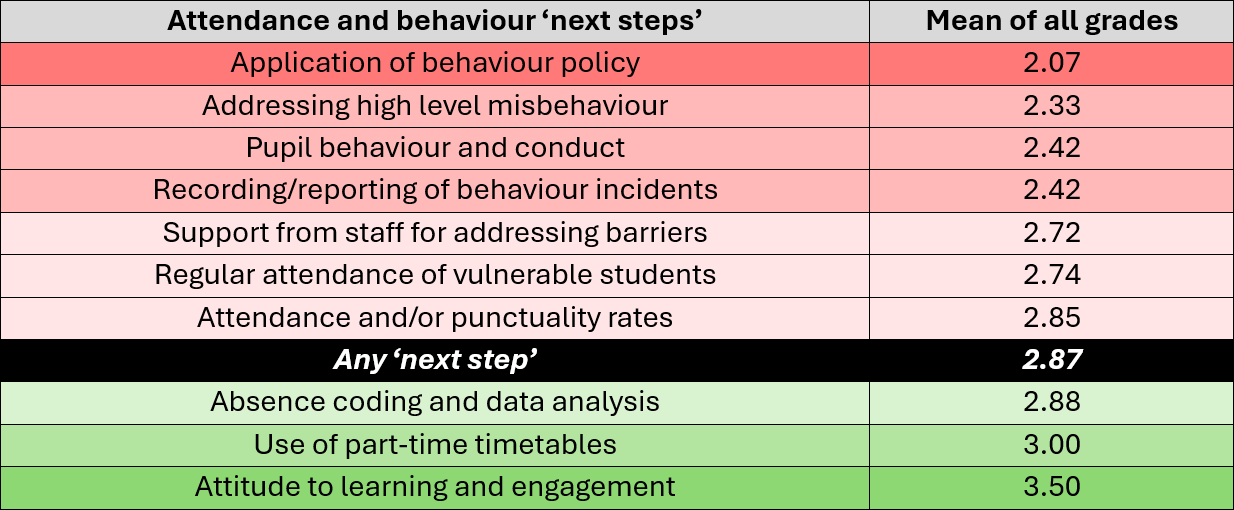
What the table shows is that ‘next steps’ around attendance are clustered around the mean for any next step, either slightly more risky or slightly less risky than schools in receipt of any next step from their Ofsted report. The riskiest of the attendance next steps is related to the attendance of vulnerable students, which is perhaps to be expected in a new framework and inspection process centred on inclusion.
By contrast, toward the top of this table in the darker shades of red (indicating much greater levels of risk for schools) are many of the next steps related to behaviour. In fact, for the top four on this list, the mean of all grades is coming out closer to the ‘needs attention’ judgement than the ‘expected standard’ judgement. Although behaviour needs are far less frequently identified in Ofsted reports than those for attendance, they carry far great risk for schools if mentioned.
Of course, any risk assessment will be based upon both the likely severity and frequency of the potential threat. As discussed above, the coupling of attendance and behaviour with a ‘secure fit’ grading system mean that the frequent but non-severe risks around attendance are likely to be as impactful as the infrequent but severe risks around behaviour.
In his speech to BETT, Oliver more helpfully said that he would continue to monitor the outcomes from inspections and think again if needed. This would be a wise move, particularly if we consider attendance and behaviour judgements under new Ofsted framework based on the deprivation and SEND needs for schools.
How do deprivation and SEND impact on judgements around attendance and behaviour?
One of the new elements of the new Ofsted reporting system is that they identify which quintile schools are in for free school meals, local deprivation indicators, EHCPs and SEN support provision. We have taken the opportunity this has afforded us to begin tracking the gradings for schools in each of these quintiles. The first table below shows the mean ‘attendance and behaviour’ and ‘inclusion’ gradings for schools by quintiles of deprivation.
We have highlighted in green the quintiles whose mean grade is higher and red for the quintiles whose score is lower than the mean grading for all schools (shown in the final row).
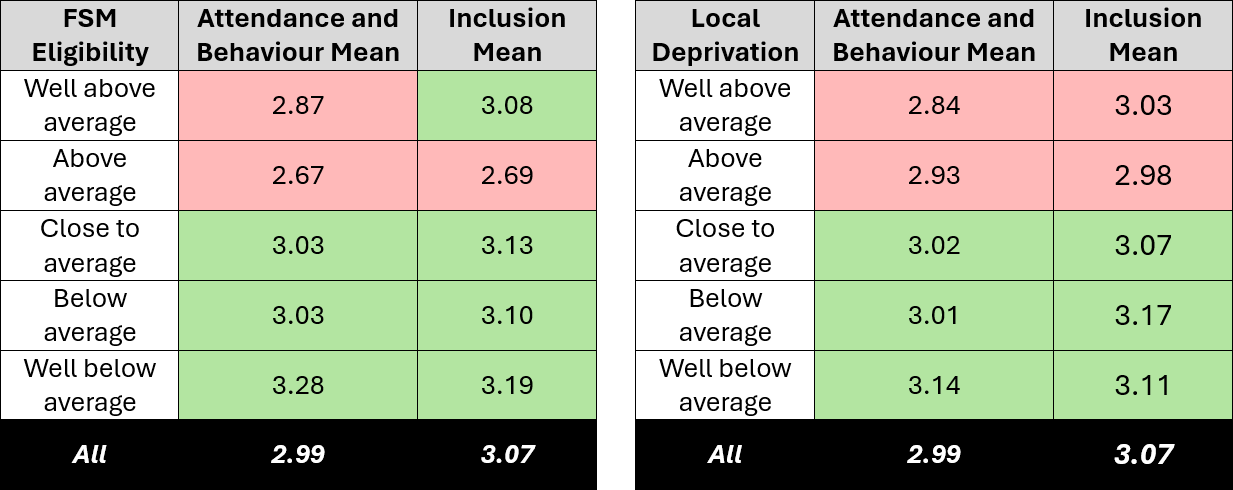
The results of looking at attendance and behaviour gradings this way are, sadly, unsurprising. Schools which are above average or well above average against these two indices of deprivation are achieving gradings well below schools with close to average and above average deprivation.
We understand disadvantaged students are far more likely to have higher rates of absence and to be persistently or severely absent. The question is whether we feel that (a) these differences are taking that into account or not, and (b) whether we feel that they ought to do so, or not.
It is also worth considering whether schools that lose out on attendance and behaviour gain on inclusion. On that one, the answer is a qualified ‘no’. Schools with well above average FSM are marginally above the mean for all schools for inclusion, but otherwise the pattern holds that the more deprived your cohort and community, the less well you do under new Ofsted gradings.
The table below shows the same information for the different quintiles of additional need, the proportion of students with EHCPs and with SEN support.
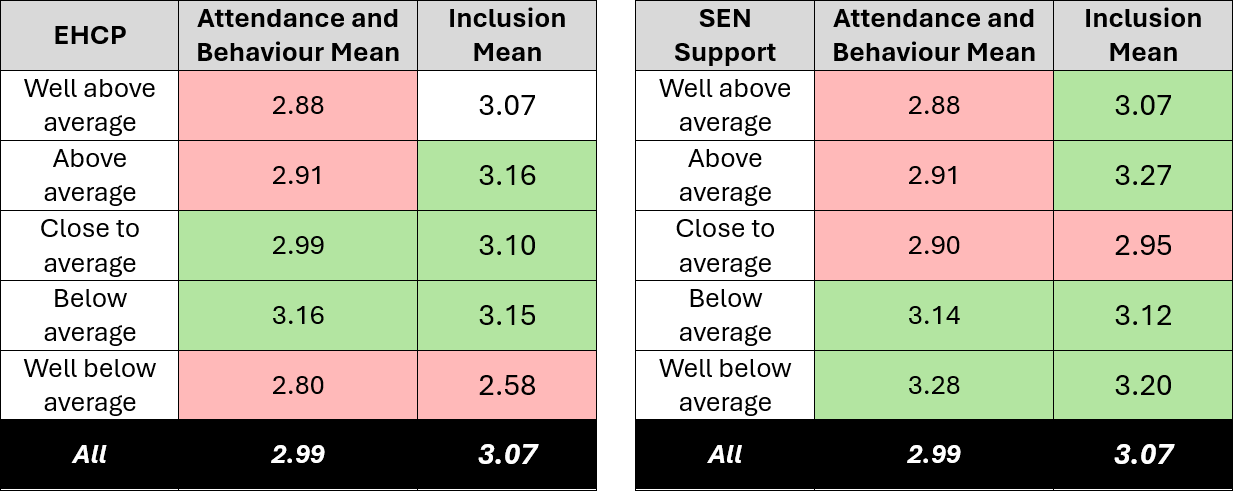
Here the pattern is more varied for attendance and behaviour but not for schools that are above average or well above average numbers of students with additional needs. These schools, like those with deprivation challenges, receive lower gradings for attendance and behaviour. The difference is that the same is true for some schools that do not have high levels of need.
Again, we know that students with additional needs are likely to have higher levels of absence, including persistent and severe absenteeism. And, as above, the question for inspections is whether greater latitude should be given to schools when grades are given because of this, or not. The inclusion judgement holds up well for schools with above average or well above average levels of students with EHCPs and SEN Support.
Conclusions
SSAT’s inspection tracker now has almost 1000 lines of data from Ofsted reports published under the new framework. The results are becoming increasingly reliable and have allowed us to draw some conclusions about how the new Ofsted framework reflects attendance concerns.
Firstly, we have shown that the new attendance and behaviour judgement area is being used much more frequently than was the case in the final two years of the 2019 inspection framework. And when we look at Ofsted ‘next steps’ specifically relating to attendance, the new framework is twice as likely to mention attendance than was the case with the previous one.
Although attendance is much more likely to be identified as a next step, this does not carry great risks of lower gradings than is the case for a school receiving any next step. By contrast, early evidence suggests that next steps related to behaviour (although less frequent) are much more likely to be correlated with lower judgements across the inspection areas.
If you are a school with above average or well above average indicators of deprivation or SEND, however, it is much more likely that you will receive judgements for attendance and behaviour than schools with lower levels of deprivation and additional needs.
We’re here to help
SSAT provide support for schools seeking to enhance their provision around attendance based on our evidence-informed ‘best bets’. From our Attendance Audit processes, to our Improving Attendance Together Programme, our focus is on helping school leaders learn from effective practice to shape their provision.
If you are interested in further insights about Ofsted inspections, you can either join us for our latest webinar exploring the data or get in touch for more bespoke work for groups of schools. We have also created a readiness for inspection audit tool and can work with schools to provide external validation of your preparedness.
Whether you are interested in attendance or readiness for inspection, we’re happy to discuss the needs of your school or trust with you. To book a call with our attendance and inspection expert, Keven Bartle, click this link.
