Embedding Formative Assessment programme

Building on over 20 years of research by Dylan Wiliam and Siobhan Leahy, independent evaluation (EEF) has shown that the EFA programme has a positive impact on pupil achievement and teacher behaviours.

Book a call

Start Date

Start date
2 year programme, flexible start date

Format

Format
In person training and online support

Info

Need more information?
Book a support call today and discover how the programme can work for your school

Embedding Formative Assessment

The importance of effective formative assessment is well-established. It is at the heart of adaptive teaching and meeting the needs of all learners. However, it remains the most frequently cited area for improvement in Ofsted reports.

Over two years, the EFA programme ensures that your team gain a confident understanding of Dylan Wiliam’s 5 Strategies of Formative Assessment and how to apply them in your setting. Collaborative Teacher Learning Community (TLC) workshops enable teachers to hone their practice, no matter what their starting point.

Register your interest

How does the EFA programme work?

The EFA programme focuses on long-term habit change to support teachers to improve their use of formative assessment.

  • A two-year programme involving all teachers.
  • Teachers work in Teacher Learning Communities (TLCs), facilitated by members of your team.
  • TLC groups meet approximately every four weeks.
  • 16 fully resourced workshops across the two year programme.
  • Support throughout from an expert EFA mentor, including:
    • An in-person training day at your school for school leaders and TLC leaders.
    • Regular email/telephone contact to support your work.
    • Two further in-person visits – at the end of year 1 and the end of year 2 to support you with evaluation and development planning.
    • Resources, exemplars and case studies tailored to the needs of you and your team.

EFA Programme Summary
Download an overview of the programmes content and sample of a Teacher Learning Community workshop using the attached.

View now

What schools are saying about the Embedding Formative Assessment programme

“There is a buzz through the staff. In terms of materials, everything is provided by the SSAT, but at the same time we can change it to adapt to our needs. Teachers have been picking and choosing what works for them, for their students, their subjects, and their classes. It’s all backed up by research – we know it works.”

Rachel, The Hayling College

“The T&L development work we have done on Embedding Formative Assessment has been the most powerful and transformative T&L strategy I have been part of during my time at Balfour. This is because it has raised standards in lessons for all students regardless of their prior attainment, gender, socioeconomic status or SEND need by giving students much more of what they individually need to succeed.”

Gary Anderson, Assistant Headteacher, Sir Graham Balfour School, Stafford

“In an ever-changing educational landscape, the EFA programme has proven to be an immensely powerful tool, not just for improving individual learning outcomes, but for fostering a positive, forward-looking school culture.”

Michael Watson, Headteacher, Hunters Bar Junior School

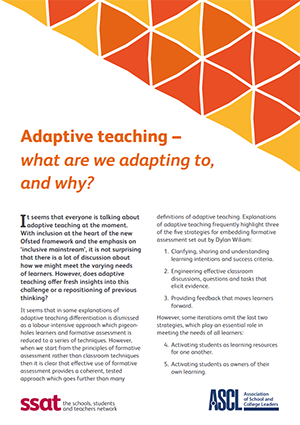
Adaptive teaching – what are we adapting to, and why?

It seems that everyone is talking about adaptive teaching at the moment. With inclusion at the heart of the new Ofsted framework and the emphasis on ‘inclusive mainstream’, it is not surprising that there is a lot of discussion about how we might meet the varying needs of learners. However, does adaptive teaching offer fresh insights into this challenge or a repositioning of previous thinking?

Read the article

EFA Toolkit

Based on over 20 years of research, this toolkit, written by Professor Dylan Wiliam and Siobhan Leahy, provides 16 fully resourced workshops for your team. Designed to form the basis of a two-year professional development programme, the workshops support your teachers to gain a confident understanding of Dylan Wiliam’s 5 strategies of formative assessment.

Find out more

Why do the Embedding Formative Assessment Programme?

In short, it works.

If you are looking to develop practice across your school in formative assessment and adaptive teaching, EFA offers an evidence-informed, proven approach which supports consistent and effective practice across your school.

Through a full randomised control trial involving 140 schools, the Education Endowment Foundation (EEF) found:

  • Learners made the equivalent of two months’ additional progress.
  • Learners in the lowest third for prior attainment made more progress than their classmates in the top third.
  • Teachers felt that the Teacher Learning Communities (TLCs) improved their practice through collaboration and valuable dialogue between teachers.

It is difficult to support meaningful, sustained change in teachers’ practice. During the two year programme, teachers gain a confident understanding of Dylan Wiliam’s principles of formative assessment, meaning that they go beyond classroom techniques to think creatively about how to embed effective practice in your context.

Book now

EFA works across all phases in education

For secondary schools

Over 400 secondary schools have already completed the EFA programme. Participating schools report boosts in learner engagement, enhanced teacher responsiveness, stronger collaboration across departments, and improvements in overall achievement.

Cost

£5,875 for SSAT members / £6,875 for non-members

For a member school with 50 members of staff, this equates to a full year of training for a teacher for only £58.75.

Contact us to discuss how EFA can support your school

Book a support call or register for the programme here.

For primary schools

By incorporating formative assessment practices, teachers and learning support staff can gain valuable insights into children’s learning, identifying gaps in knowledge, and misconceptions, adapting teaching to meet individual needs, ultimately enhancing learner achievement and engagement. Join the growing network of primary schools already doing EFA.

To support primary schools to join the programme, there is now the option for primary schools to join the programme as a cluster, supporting collaboration between schools and sharing the cost.

Read a case study about EFA in a primary school

Watch video

Book a support call to explore whether EFA is a good fit for your school or to learn more about joining as a cluster.

Cost

Single school: £5,875 (SSAT member) / £6,875 (non-member)
Two school cluster: £6,600 / £7,600 (£3,300 / £3,800 per school)*
Three school cluster: £7,325 / £8,325 (£2,441.67 / £2,775 per school)*

*Cluster pricing includes 2/3 schools purchasing the EFA toolkit and individual mentor visits to each school.

For specialist schools

EFA has been delivered very successfully in specialist schools, including alternative provision settings. The TLC workshops focus on the principles of effective formative assessment, which enables participants to explore their implementation in different contexts.

Read a case study about EFA in a specialist setting

Cost

Single school: £5,875 (SSAT member) / £6,875 (non-member)

Smaller specialist settings (fewer than 500 pupils) can opt to join the programme as a small cluster to support collaboration and share the cost:

Two school cluster: £6,600 / £7,600 (£3,300 / £3,800 per school)*
Three school cluster: £7,325 / £8,325 (£2,441.67 / £2,775 per school)*

*Cluster pricing includes 2/3 schools purchasing the EFA toolkit and individual mentor visits to each participating school.

Book a call to discuss how EFA could work for you.

For MATs and groups

Multi-Academy Trusts and groups can adopt the EFA programme across their schools. We work with MAT leaders to ensure the programme fits your context and supports trust-wide priorities.

Option 1 – Group discount

Participating schools are trained and supported by an EFA mentor

Programme pricing (excluding the EFA toolkit)
1 school: £5,500
2 – 3 schools: 10% discount
4 – 6 schools: 15% discount
7 – 9 schools: 20% discount
10 schools: 25% discount

Option 2 – In-house delivery and option to become an EFA franchise

Members of your team are trained to be able to train and support other schools through the programme.

  • £2,250 setup fee (including mentor training, resources, 2-year licence, and IP)
  • £1,995 per participating school for the 2-year licence period (includes full EFA toolkit)
  • Available only to MATs where at least one school has already completed EFA
  • Opportunity to deliver training to schools within and beyond your MAT.

Book a call to discuss how EFA could work across your MAT.

For international schools

EFA has been delivered successfully internationally and we have supported groups of schools with UK study visits. Training for international schools can be delivered online or in-person. Contact us to discuss your requirements.

Option 1 – Individual school

SSAT member – £5,875, non-member £6,875

Option 2 – Group discount

Participating schools are trained and supported by an EFA mentor

Programme pricing (excluding the EFA toolkit)
1 school: £5,500
2 – 3 schools: 10% discount
4 – 6 schools: 15% discount
7 – 9 schools: 20% discount
10 schools: 25% discount

Option 3 – In-house delivery and option to become an EFA franchise

Members of your team are trained to be able to train and support other schools through the programme.

  • £2,250 setup fee (including mentor training, resources, 2-year licence, and IP)
  • £1,995 per participating school for the 2-year licence period (includes full EFA toolkit)
  • Available only to groups where at least one school has already completed EFA.
  • Opportunity to deliver training to schools within and beyond your group.

Please note, travel costs would be payable in addition to the figures quoted.

Book a support call to discuss how EFA could work in your school.

Choose a different phase

Case studies

Don’t just take our word for it. View these case studies:


Empowering teachers and students: The impact of Embedding Formative Assessment
Anne Johnson, Deputy CEO and Charlotte Carter, Pastoral & maths teacher, Catcote Academy

Discover how Catcote Academy’s innovative use of the Embedding Formative Assessment (EFA) programme transformed teaching practices and significantly improved student outcomes. This case study highlights the power of collaborative teacher development and adaptive assessment techniques in a supportive environment, making a lasting impact on students with diverse needs.

Read case study


Embedding Formative Assessment: not just a box-ticking exercise but something long-term and meaningful for all
Mrs Jo Allan, Junior Assistant Vice Principal, Castle View Enterprise Academy

Two years on, the impact of the EFA programme is clear. Our school culture has transformed. Staff feel empowered to take ownership of their professional development, and there’s a genuine sense of collaboration across departments.

Read case study


Read more EFA success stories

Book a call with the EFA team

Speak with the EFA team to learn more about the benefits of Embedding Formative Assessment in your school.

Book a call


Gain credits with the Chartered College of Teaching

Those who complete the EFA programme will be able to apply for an exemption from the Development of Teaching Practice Award for teachers (20 credits).

Find out more


Going Further with Formative Assessment

Are you looking to sustain the impact of the Embedding Formative Assessment programme? This new support package provides training for new members of your team, professional development for strategic leaders and workshop resources for your TLCs.

Find out more


Frequently Asked Questions

What is the research evidence for the impact of the programme?

An Education Endowment Foundation randomised control trial with 25,000 pupils in 140 schools across England found:

  • learners made the equivalent of two months’ additional progress in their Attainment 8 GCSE score
  • learners in the lowest third for prior attainment made more progress than their classmates in the top third
  • teachers felt the Teacher Learning Communities (TLCs) improved their practice by allowing valuable dialogue between teachers and encouraged experimentation with formative assessment strategies
+

What is the time commitment for the programme?

The programme lasts two years from your starting point. In each year there will be 8 workshops. 75 minutes must be allowed for each workshop. Time must be planned between workshops to enable teachers to work collaboratively and give feedback on techniques observed in lessons.

+

Why is the programme two years?

Teacher change takes time. The programme focuses on teachers being given choice, flexibility, small steps, accountability and support to effect long-term habit change. Initially, schools reported an increased prevalence of formative assessment techniques and improved student engagement, but effectiveness and impact on student outcomes is a longer term goal. One year, simply isn’t enough.

+

Who needs to be involved?

This is a whole-school programme. All teachers should be a member of a TLC group.

+

What topic areas that will be covered over the two years in the TLCs?

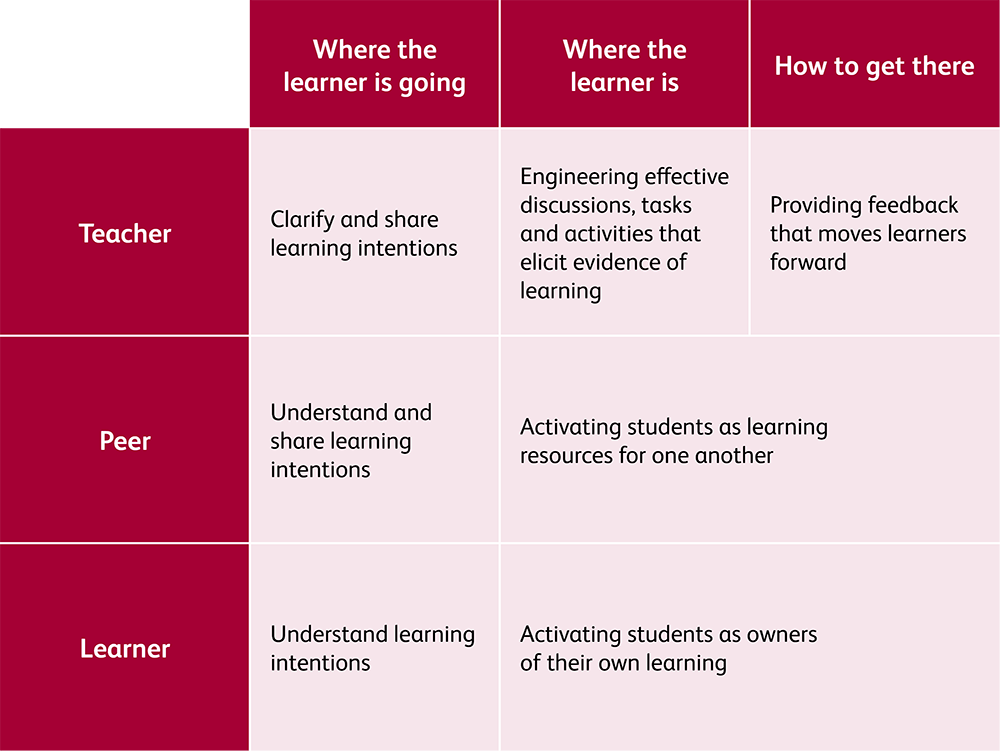
Over the two years, Dylan Wiliams’ five strategies for formative assessment will be covered. These include:

+

What support and training is provided?

Each school will have an expert EFA mentor who will work with you for two years. This support includes:

  • Practical planning support for readiness
  • An initial day’s training in-school or online for school leaders and pre-selected TLC Leaders. Note, this is not an all staff training day
  • Regular email/telephone contact with your mentor with key reflection and planning points
  • Two face to face visits at the end of year one and two to review the programme and plan the next steps in implementation
  • A wide breadth of additional supporting resources, exemplars and case studies which can be used to support and maximise the impact of the programme
+

How many teachers should be in each TLC?

We would advise a group size of around 10, groups may need to be as low as 8 or as high as 14 depending on school circumstances.

+

Can learning support staff be part of TLC groups?

Yes. Many schools involve support staff in the programme. These staff can either form part of the TLC groups with teachers where you feel they would be comfortable and confident to share their practice. Another option is to form a TLC of only these staff to allow discussions to become more focused on their role.

+

Will all TLCs in a school work on the same topic at the same time?

Yes, it is integral to the success of the programme that they follow the agendas provided. Some adaptations may be made, but these must be discussed with your EFA mentor to prevent lethal mutations of the programme. However, teachers have choice as to what formative assessment technique they wish to work on in their own classrooms to develop their practice.

+

How should I choose my TLC workshop leaders?

TLC Leaders should be voluntary and ideally not members of the senior leadership team. Their role is to facilitate the sessions. They are not expected to be experts in formative assessment and may be at any point in their career. They will lead and participate in all of the TLC activities.

+

What monitoring will be required both internally and externally?

Internal monitoring and evaluation of the programme will be supported by your EFA mentor and is an essential element of the implementation of the programme. This would form part of your usual monitoring of T&L. The resource contains pro-formas for peer observations and learning walks. Externally, the evaluation team may ask you to complete student/teacher surveys or also be part of group interviews. These will be done at a time convenient to you.

+

What about part time staff?

This will always be a challenge in schools. Where possible, all staff should attend all meetings. However, this isn’t always possible so we recommend giving staff who can’t attend sessions a ‘buddy’ from the group that can support them in sharing discussions and learning. Recordings from the sessions are also available on the final handout so these can be watched at anytime.

+

What if a TLC Leader is absent for one or more of the workshops?

This will happen over the course of the programme. We recommend that every TLC group has two TLC Leaders, either as co-leaders, or with a deputy lead.

+

What is the difference between formative assessment strategies and techniques?

The five key strategies of formative assessment are identified in the table above. The techniques that can be used to enact these strategies in the classroom are, for example; no hands up, exit tickets etc.

+

Any questions?

Contact us or call 020 7802 2300.

Get in touch