
Blowing Hot and Cold: The New Ofsted Framework and the Challenge of Leading on Behaviour
14 April 2026
By Dr Keven Bartle
In this blogpost, I want to return to a common theme since I began tracking inspection reports in September 2023: the ambivalence of Ofsted with regards to behaviour. I will show how there has been a continued decline in inspection focus on behaviour, and how this has come to make it seem like the very poor cousin of attendance in the new ‘Attendance and Behaviour’ judgement area. But, drawing upon how the new grading system is playing out for schools, I will also be showing that this low frequency masks a significant risk for schools that are given a ‘next step’ around behaviour.
How frequent are behaviour concerns in Ofsted reports since November?
The table below shows the frequency of specific ‘next steps’ related to behaviour in two ways. The first is the percentage of that next step as a proportion of all next steps identified in Ofsted reports published since the start of the new framework, up to those published on 1st April 2026. The second is the ranking of that frequency compared to all next steps.
The first column of data is for all schools, followed by primary schools and secondary schools. The final row imagines the aggregation of all behaviour next steps as a percentage of and ranking amongst all other next steps. It is worth noting that there have been 60 different next steps for all schools, 53 for primaries and 44 for secondaries.
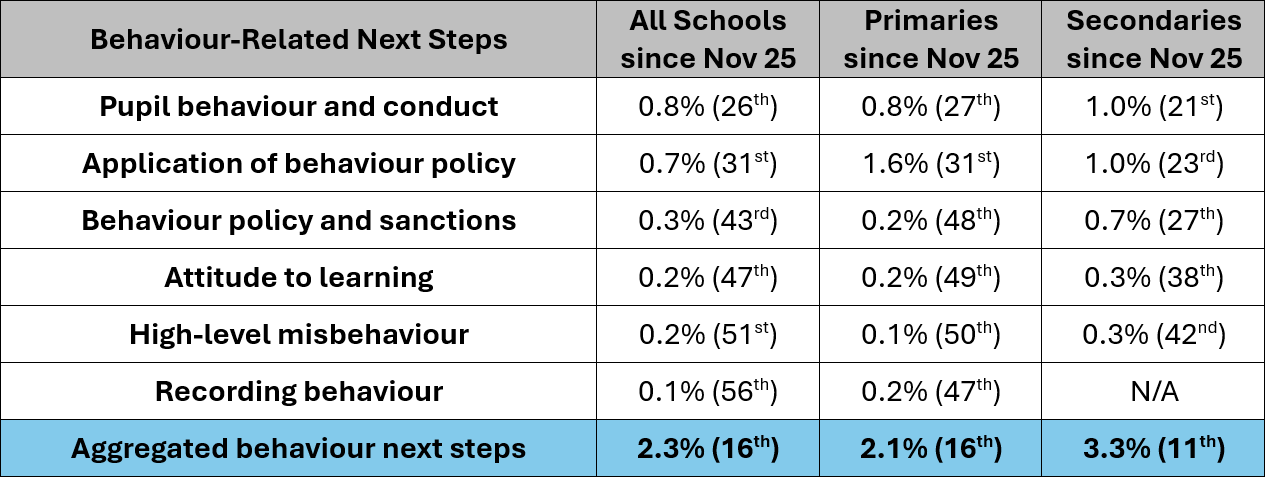
If we start the analysis at the end, with the aggregated frequency as a percentage, we can see that behaviour is a surprisingly infrequently identified improvement need by Ofsted. Fewer than one in forty ‘next steps’ since November 2025 have been about behaviour and that figure is close to one in fifty for primary schools. To put that into even clearer context, improving attendance is appearing as one in ten of every next step identified since November.
Even considering secondary schools, the proportion of behaviour next steps is just one for every thirty identified improvement needs. None of the individual behaviour needs for secondaries ranks inside the top twenty and, if we put them all together as a single need, that need would not make it into the top ten.
To put it simply, there is nothing about the frequency of Ofsted ‘next steps’ that would suggest that behaviour should be in the top tier of concerns for school leaders whose schools are “in the window”. Of course, there is a big BUT coming later in this blogpost, but for now let’s probe further on the issue of frequency by looking at how behaviour improvement needs have changed over time.
What has happened to the frequency of behaviour concerns in Ofsted reports?
The first table in this section of the blogpost adds a column of data about each of the next steps around behaviour for the whole of the 2023-24 and 2024-25 academic years. As with the earlier table, the frequency is shown both as a percentage of all improvement needs and as a ranking within all those improvement needs (of which there were 63 during this two-year period).
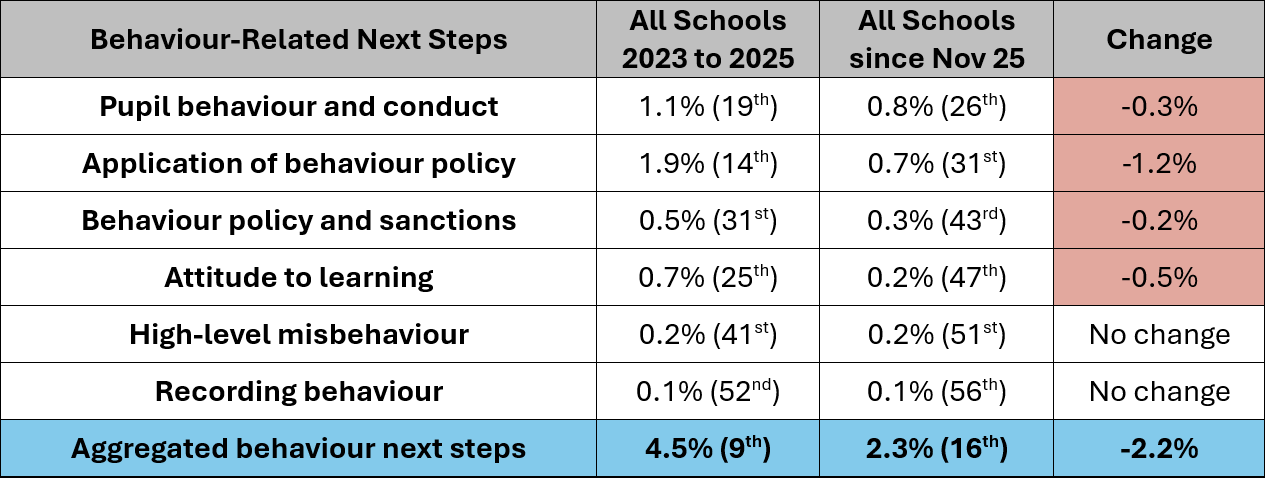
As earlier, it is worth starting with the bottom line, which shows that behaviour concerns have dropped in frequency by almost a half and have fallen well down the ranking against all improvement needs. In fact, each of the specific needs have dropped down the rankings, even where the frequency of their appearance in inspection reports has not notably changed.
The one ‘next step’ that has seen the sharpest decline in its prevalence in Ofsted reports is the focus on the consistency in which behaviour policies and processes are applied by staff.
As I have outlined on three previous blogposts (which you can find here, here and here) it is incredibly striking how behaviour has been fading away from the focus of inspection teams over the past two years. When considered alongside the findings of the National Behaviour Survey over a number of iterations, as well as many other publications, it is hard to understand why behaviour next steps have been reducing in frequency over such a long period.
What has happened to the behaviour next steps in relation to attendance next steps?
It has been well documented how attendance and behaviour have become awkward bedfellows within a single inspection area. The table below indicates that there is indeed a problem with the decision to keep the two together, but perhaps not for the reasons one might expect.
The left-hand column shows the individual behaviour ‘next steps’ as a proportion of all attendance and behaviour next steps in the final quarter of inspection activity of the Spielman era. The middle column shows the same data for the first quarter of inspection activity under Oliver’s new framework, with a final column to show how much things have changed.
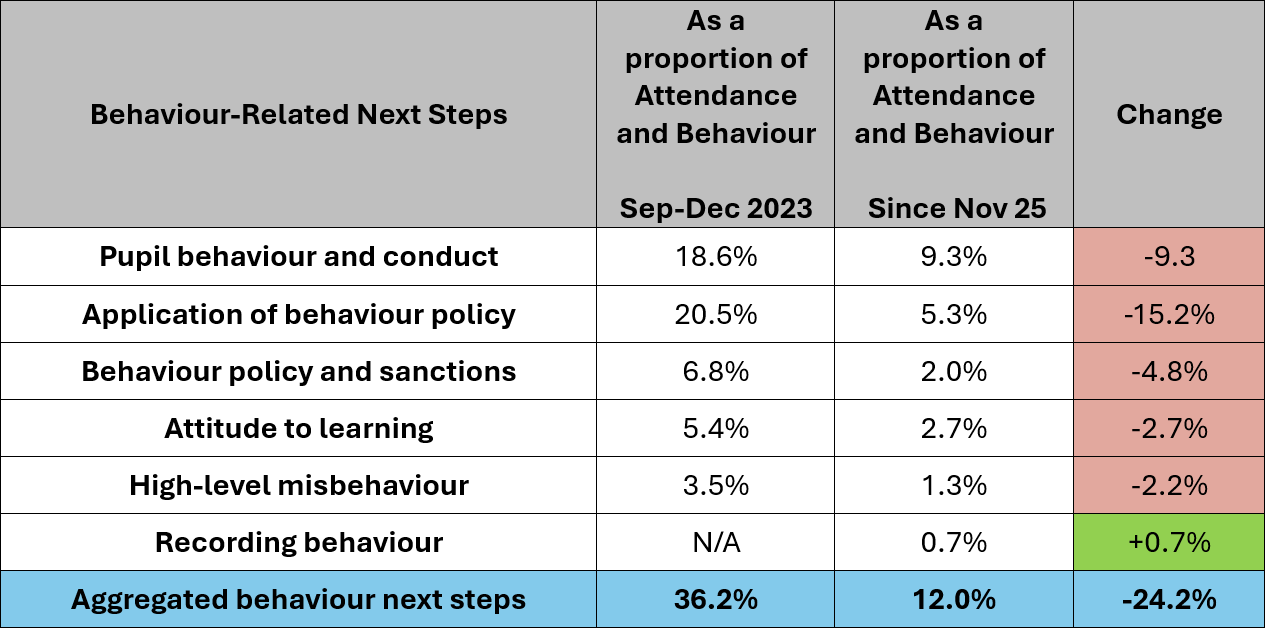
It is worth noting that attendance and behaviour in the final quarter of 2023 accounted for 9.1% of all improvement needs and that that figure has risen to 12.4% of all next steps under the new framework. Which means that the size (not just the share) of the behaviour slice of the attendance and behaviour pie has significantly shrunk, even though the size of the pie itself has significantly grown.
All of which would seem to support the idea that attendance needs might be causing problems for schools whose behaviour culture is in a good place. And this might be the case. But, so far, we have only been considering the frequency of behaviour next steps. To get the truest picture of whether behaviour is the poor cousin of attendance, it is worth considering the relative risk for schools that receive a ‘next step’ that focuses on behaviour.
How risky are behaviour concerns in Ofsted reports?
The final table we will be looking at shows the relative risk of the behaviour next steps based on the average grades received for all judgement areas for all schools receiving those next steps. We get to this numerical figure by ascribing an exceptional grade 5, a strong standard grade 4 and so on down to a 1 for each urgent improvement grade.
One point of comparison is the dark blue line which shows the average grade for any next step identified in an inspection report, which is 2.83 (or just below the expected standard). Another point of comparison is the ‘riskiness ranking’: the lower the number the higher the risk of a low average grading for a school receiving that next step. For a further point of comparison, I have included, in the final column, the frequency ranking discussed earlier in this blogpost.
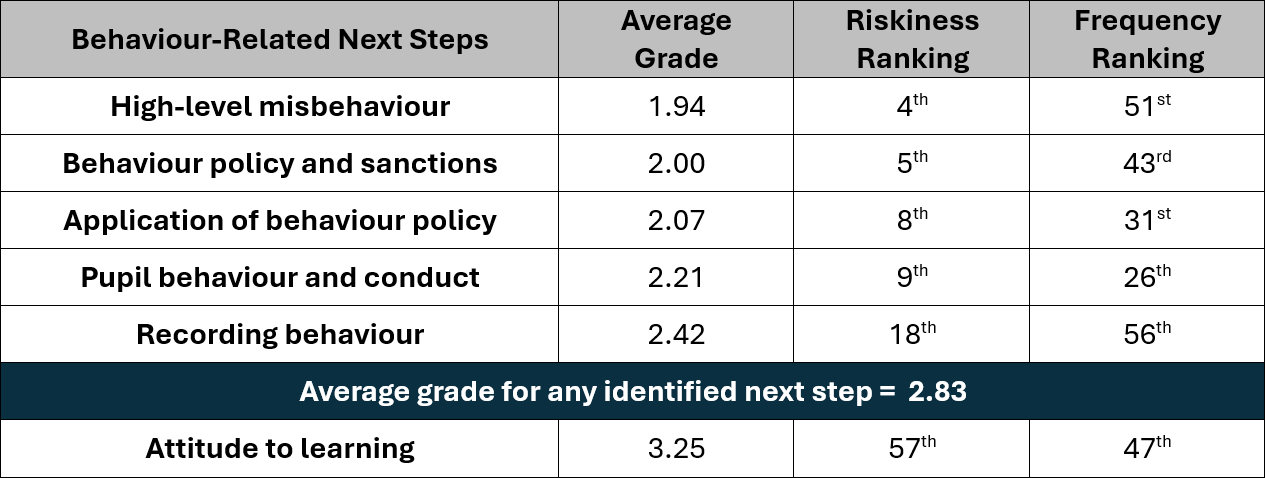
What this table shows is that behaviour next steps, whilst low in frequency, carry a great deal of risk for schools. Four of the six types of behaviour next steps are in the top ten riskiest identified improvement needs. For context, concerns about a school’s safeguarding processes (but not their adherence to statutory duties) are ranked 20th for risk. And general comments around a school needing to improve attendance are ranked 30th for risk with an average grade of 2.74.
And so, whilst behaviour next steps are quite rarely used by inspection teams under the new framework, when they are used, they pack quite a punch. Where a school is noted for issues with high level misbehaviour, ineffective policy, and inconsistent application, they are averaging at the ‘needs attention’ level. Only the next step around pupils’ attitudes to learning averages above the mean for all next steps and can be considered low in risk.
Conclusion: Leading behaviour under the new inspection framework is complex
In the introduction, I spoke about the ambivalence of Ofsted reports towards behaviour, something I have tried to capture in the title of the blogpost with the idea of the inspectorate ‘blowing hot and cold’. By ambivalence, I mean the simultaneous but contradictory messages that are being communicated by the data on how the new inspection framework is playing out. Where does this leave school leaders with responsibility for behaviour?
In terms of blowing cold, there is no doubting the decline in focus on behaviour for Ofsted inspection teams. And this has been going on for some time. The data shows that attendance concerns have come to overwhelmingly dominate behaviour concerns in terms of their frequency within the overall ‘Attendance and Behaviour’ judgement area. Consequently, as a proportion of all ‘next steps’ for improvement, behaviour needs have been whittled away from almost one in every twenty needs over the last two academic years, to fewer than one in every forty needs since the November 2025 introduction of the new framework.
But this doesn’t tell the full story. Ofsted appear to be blowing very hot when it comes to the impact of behaviour next steps on school judgements. Most of the commonly identified behaviour improvement needs are much more likely to lead – in part, at least – to a string of ‘needs attention’ or ‘urgent improvement’ judgements for a school.
The contrast between the low frequency rankings of behaviour next steps and their riskiness rankings – the hot and the cold winds of Ofsted – make the leadership of a behaviour culture within a school very challenging. Apart from “attitude to learning”, which is both low frequency and low risk for school leaders, every other potential behaviour concern is a potential tornado or hurricane ready to wreak destruction. As multiple recent surveys have demonstrated, and as the experience of school leaders has shown, such winds can develop with startling rapidity to blow seemingly even the sturdiest of ships off course.
Which is why SSAT are happy to provide a safe harbour for school leaders with responsibility for behaviour. Whether it is through supporting you in self-evaluating your behaviour culture, or helping you navigate the complexities of your role as behaviour lead with others, or something more bespoke, we are happy to help.
Behaviour support
Are you a school leader responsible for behaviour? We offer a national network of peers tackling the most complex and common behaviour challenges in schools today, as well as a behaviour audit tool and a full support programme.
Dr Keven Bartle, Director of Education, SSAT

Keven is Director of Education at SSAT and leads the organisation’s educational strategy. A former school leader and headteacher, he leads a team committed to the transformative power of education as a vehicle for social justice. His work involves identifying key trends in education policy and practice to provide helpful and sustainable solutions for school leaders and staff striving to improve the lives of children, families and communities.
Recommended
Readiness for Ofsted Inspection Audit Tool
Set your school or MAT up for success with the new Ofsted framework. Our invaluable new audit tool for school leaders ensures you are fully prepared when your call comes.
Ofsted Inspection Insights
We have the data from every Ofsted inspection ready for you. Learn the emerging trends and the issues facing schools with our comprehensive, segmented analysis of inspection reports.
ASSIST
If you need rapid, focused improvement right now, we can support you with a bespoke, hands-on, strategic programme tailored to your specific needs.
School improvement solutions
Working sensitively within your context, we work with you and your team to support you to overcome the different challenges you are facing. From attendance and behaviour, working with parents to DEIB and more.
Framework for Exceptional Education
Wherever you are in your school improvement journey our trusted framework supports self-review and action planning. Covering 12 key areas of practice.
Back to top
